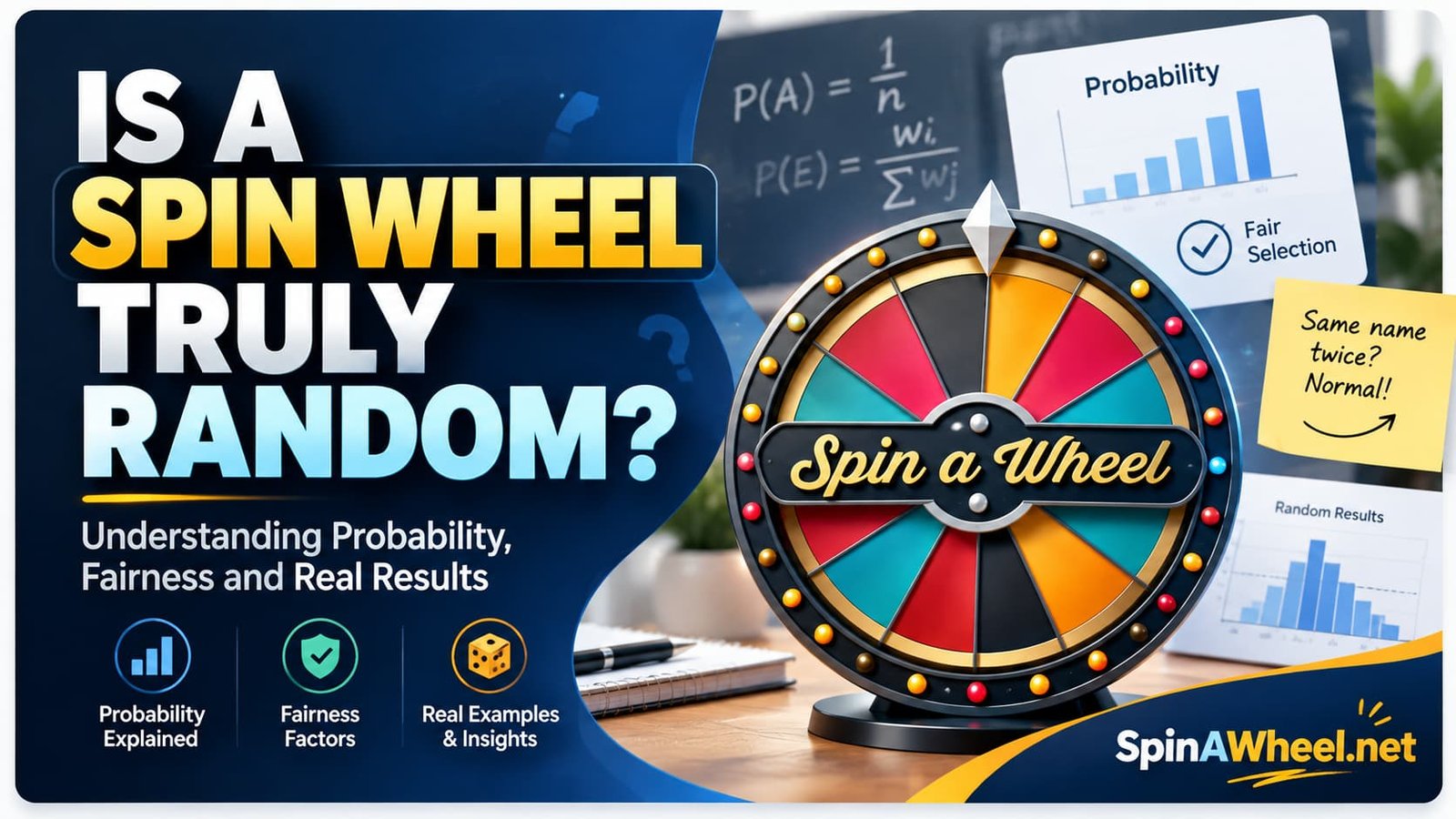
Picture this: You are a classroom teacher calling on a student for an oral quiz, or a Twitch streamer giving away a gaming headset to one lucky subscriber. You load up an online wheel, click Spin, and watch the wheel blur. It slows down, clicks across the pegs, and lands on Sarah. Everyone cheers.
Five minutes later, you spin again... and it lands on Sarah a second time.
Instantly, the room erupts or your live chat floods with one angry word: "RIGGED!"
Was the wheel actually glitched? Did an algorithm cheat? Or did you just witness pure, honest mathematical randomness in action?
This exact scenario causes headaches for educators, contest hosts, and anyone using digital pickers. Humans naturally crave patterns, fairness, and turn-taking. But true mathematical randomness doesn't play by human social etiquette. In this deep dive, we'll strip away the mystery: how digital wheels calculate winners in under a millisecond, why back-to-back repeats are completely normal, the hidden algorithmic traps that ruin cheap spinners, and how you can verify any wheel's fairness for yourself.

The "Spotify Shuffle" Problem: Why Real Randomness Feels Broken
To understand why a wheel picks the same name twice, you first have to understand a fascinating quirk of human psychology: humans hate true randomness.
Back when Apple first introduced the iPod shuffle feature, and later when Spotify launched its music shuffle, users flooded forums with furious complaints. They claimed the shuffle algorithm was broken because the same artist would play three times in a row, or two songs from the same album played back-to-back.
Spotify's engineers checked their code. The shuffle wasn't broken at all—it was too random! In pure probability, clusters, repeats, and streaks happen all the time. But people don't want true randomness; they want evenly distributed variety. Spotify ultimately had to rewrite its algorithm to make it less random so it would feel more random to human ears.
When you spin a digital wheel, you experience that exact same cognitive illusion. If you flip a coin and get Heads five times in a row, you feel like Tails is "due." In probability, this is called the Gambler's Fallacy. The coin doesn't remember what happened on the last toss, and a digital wheel has no memory of who just won.
How Digital Wheels Actually Pick a Winner (The 0.001-Second Truth)
Here is a secret that surprises almost everyone: The spinning animation does not decide who wins.
When you spin a physical wheel at a carnival, the outcome is decided by physics: friction on the axle, aerodynamic drag, the stiffness of the plastic flapper pin, and how hard the host pulled the rim. It is a continuous physical event.
A digital wheel is completely different. The moment your finger clicks "Spin," an algorithm calculates the winning entry in less than 0.001 milliseconds. The 4-to-6 second spinning animation that follows is pure visual theater created to give you the suspense and excitement of a physical game show!
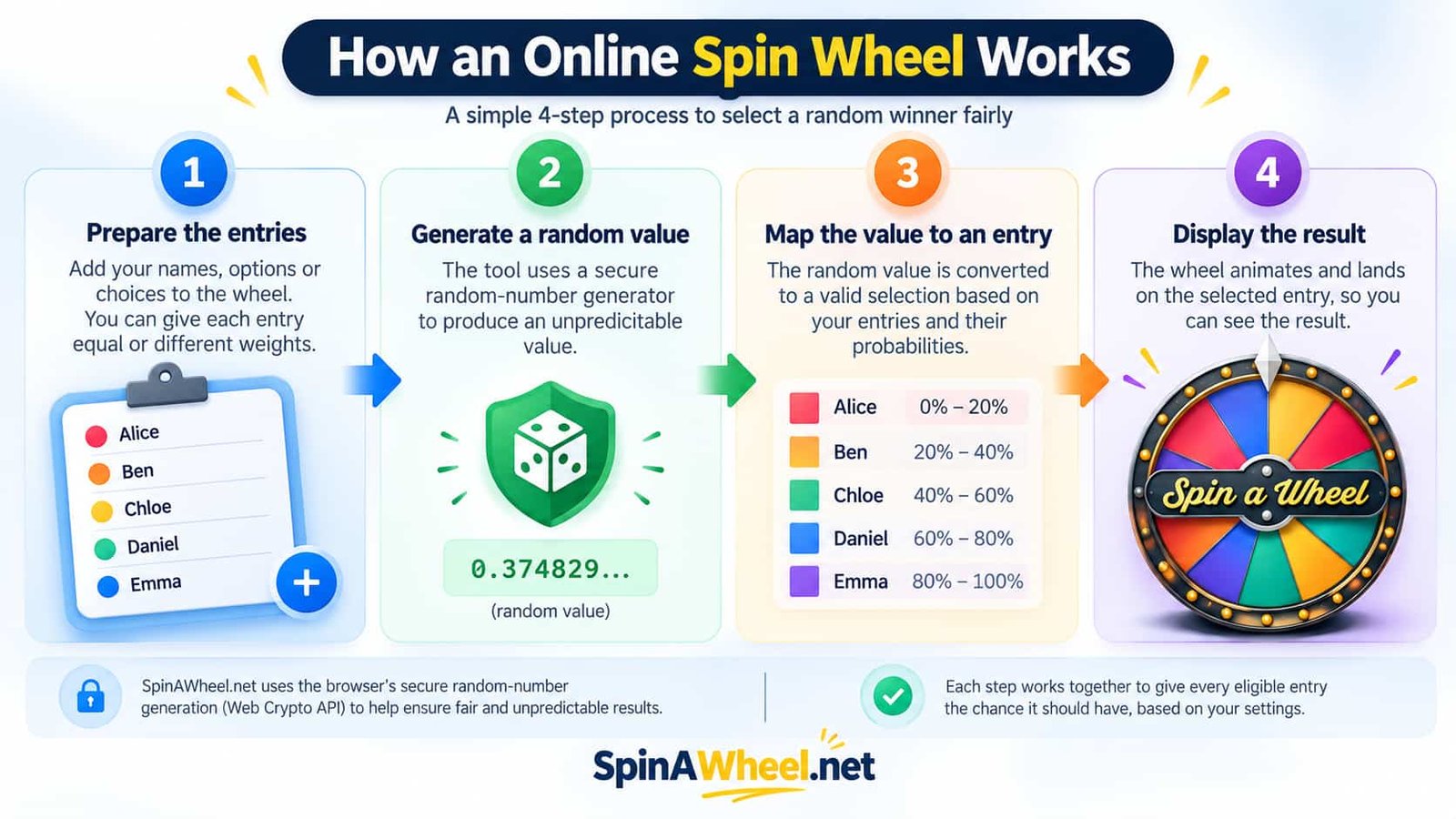
Behind the scenes, every reliable digital spinner follows this four-step pipeline:
- Array & Weight Setup: The application catalogs all active options (e.g., 25 student names) and reads their assigned weights.
- Cryptographic Random Value Generation: The browser requests a random numeric value from an entropy source.
- Index Mapping & Bias Rejection: The random value is converted into an exact entry index (from 0 to 24) without distorting the odds.
- Visual Deceleration Synchronization: The application calculates the exact angle of Sarah's slice on the wheel, adds several full 360° revolutions, and applies a smooth cubic-bezier easing physics curve so the pointer gracefully halts on Sarah.
Because the result is chosen before the wheel even starts rotating, the crucial question isn't how smooth the animation looks—it's how that random number was generated in Step 2 and Step 3.
The Dark Side of Cheap Spinners: Math.random() & Modulo Bias
Not all online wheels are created equal. In fact, roughly 90% of free spinner websites on the internet suffer from two subtle, invisible flaws that ruin their fairness.
Flaw #1: Relying on Basic Math.random()
Most web developers build quick tools using JavaScript's built-in Math.random() function. In modern browsers like Chrome and Safari, Math.random() uses a pseudo-random number generator (PRNG) called XorShift128+.
While XorShift128+ is lightning fast for rendering CSS visual effects or casual games, it is not cryptographically secure. It generates numbers based on an internal mathematical formula that starts from a predictable seed. Over large datasets, pseudo-random generators can develop subtle periodicity and clustering patterns that introduce statistical favoritism.
Flaw #2: Modulo Bias (The Hidden Mathematical Trap)
An even worse issue in amateur wheel apps is modulo bias. Let's say a computer generates a random whole number between 0 and 99 (giving 100 possible outcomes), and your wheel has 30 entries.
A lazy programmer will use the modulo operator (%) to pick an entry: randomNumber % 30.
Here is why that is fundamentally broken: 100 divided by 30 is 3, with a remainder of 10. That means:
- Entries 0 through 9 have 4 chances to win (outcomes 0–9, 30–39, 60–69, and 90–99).
- Entries 10 through 29 only have 3 chances to win (outcomes 10–29, 40–59, and 70–89).
Without realizing it, the developer just gave the first 10 people on the list a 33% higher chance of winning than everyone else! That is why amateur raffle wheels often feel biased—because mathematically, they are!
The Solution: CSPRNG via the Web Crypto API
Professional platforms don't use Math.random() or sloppy modulo arithmetic. Instead, they tap into the browser's native Web Crypto API using window.crypto.getRandomValues().
A Cryptographically Secure Pseudo-Random Number Generator (CSPRNG) doesn't rely on simple math formulas. It pulls unpredictable physical entropy directly from your operating system—such as microsecond hardware clock jitter, CPU thermal fluctuations, and memory interrupt timings. Combined with rejection sampling (which discards uneven remainder values in nanoseconds), every single slice is guaranteed perfectly uniform probability.
For example, both our binary Yes or No wheel and our Random Number Wheel run on this exact Web Crypto CSPRNG architecture on every single spin.
Why the Same Result Can Appear Twice in a Row (The Math of Streaks)
Let's return to the classroom scenario: A wheel has 25 names. Sarah just won. You spin again, and Sarah wins again. How could that happen if the wheel is fair?
Let's do the math:
On any single spin of a 25-name wheel, Sarah has an exact probability of:
Now, Sarah wins Spin #1. What is Sarah's probability of winning on Spin #2? It is still exactly 4.0% (1 in 25).
Each spin is an independent event. The wheel doesn't say, "Sarah already answered a question, so I should skip her." Unless you explicitly remove Sarah from the wheel, her slice is just as physically present on Spin #2 as it was on Spin #1.
The 7-Spin Repeat Shock: The Birthday Paradox in Action
Here is where human intuition gets completely fooled. Most people assume that if you have 25 names and spin the wheel 7 times, you will almost certainly get 7 different people.
In reality, the exact opposite is true.
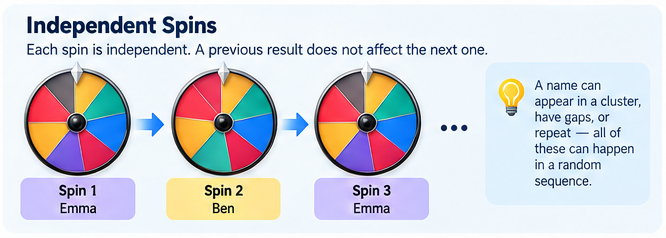
Let's calculate the probability of getting zero repeats across 7 spins:
- Spin 1: Any of the 25 names can win (25/25 = 100%).
- Spin 2: Must be one of the remaining 24 names (24/25 = 96.0%).
- Spin 3: Must be one of the remaining 23 names (23/25 = 92.0%).
- Spin 4: Must be one of the remaining 22 names (22/25 = 88.0%).
- Spin 5: Must be one of the remaining 21 names (21/25 = 84.0%).
- Spin 6: Must be one of the remaining 20 names (20/25 = 80.0%).
- Spin 7: Must be one of the remaining 19 names (19/25 = 76.0%).
Read that number again: 60.3%. In just seven spins of a 25-name wheel, you are mathematically more likely to see a repeat than not! If your classroom wheel lands on a duplicate student during a short 10-minute quiz, it isn't broken—it is behaving exactly as laws of probability predict.
Sampling With Replacement vs. Elimination Mode
The confusion between randomness and fairness usually comes down to one statistical distinction: Sampling With Replacement vs. Sampling Without Replacement.
| Method | How It Operates | Can Names Repeat? | Ideal Use Case |
|---|---|---|---|
| With Replacement (Standard Spin) |
The winning entry stays on the wheel for the next spin. Total odds never change. | Yes, freely. | Coin toss games like the Yes or No Wheel, dinner pickers like What to Eat Wheel, or ongoing party games like the Truth or Dare wheel. |
| Without Replacement (Elimination Mode) |
The winning entry is automatically deleted after winning. Remaining slices expand to fill 360°. | No. Every entry wins exactly once. | Calling on all students fairly with our Name Picker Wheel, drawing multi-tier raffle prizes, or tournament brackets. |
If you are a teacher who wants every child to participate once, or a giveaway host giving away 1st, 2nd, and 3rd place prizes, you should never use standard independent spins. Instead, turn on Elimination Mode. Check out our step-by-step guide to using Elimination Mode to see how to remove winners with a single click.
Equal-Chance Wheels vs. Weighted Probability Wheels
Not every wheel is supposed to give everyone equal odds. Many wheels are intentionally built with custom weights.
In a weighted wheel, the size of each slice—and its statistical chance of winning—is determined by its weight relative to the sum of all weights combined:
For example, imagine a 3-person raffle where participants bought different numbers of tickets:
| Participant | Tickets (Weight) | Winning Odds | Visual Slice Arc |
|---|---|---|---|
| Alice | 1 ticket | 1 ÷ 10 = 10% | 36° |
| Ben | 3 tickets | 3 ÷ 10 = 30% | 108° |
| Chloe | 6 tickets | 6 ÷ 10 = 60% | 216° |
| Total Pool | 10 tickets | 100% | 360° |
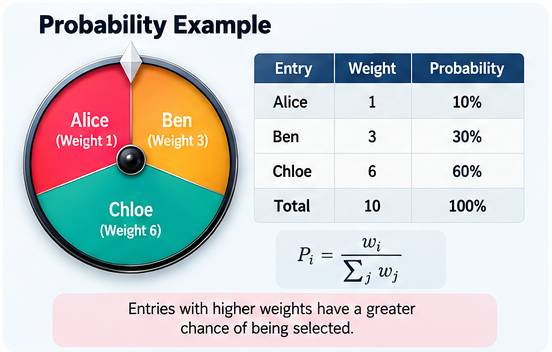
In this scenario, Chloe has a 60% chance of winning on every single spin. If Chloe wins three times in a row, nobody should be surprised—she owns more than half the wheel!
Weighted wheels are completely fair as long as the rules are transparent. Problems only arise when a shady contest host promises equal odds while secretly assigning higher weights to their friends in the backend code.
How to Statistically Verify Wheel Fairness (The 10,000 Spin Test)
How do data scientists and mathematicians prove that a wheel is genuinely fair? You can't tell from 5 or 10 spins. You need the Law of Large Numbers.
The Law of Large Numbers states that as the number of trials increases, the actual observed outcome frequency will converge toward the theoretical probability.
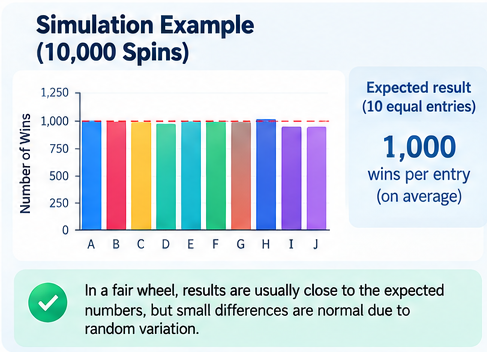
Suppose you put 10 equal options on a wheel and spin it 10,000 times. In a perfect theoretical world, each option would win exactly 1,000 times (10.0%).
In the real world, natural entropy creates minor, healthy fluctuations: Slice #1 might finish on 1,014 wins, Slice #2 on 988, and Slice #3 on 1,005. In fact, if every single slice landed on exactly 1,000 wins, that would be proof of a fake, rigged counter rather than true randomness!
The Chi-Square (χ²) Goodness-of-Fit Test
To mathematically confirm whether those small deviations are normal or evidence of bias, statisticians use the Chi-Square (χ²) Goodness-of-Fit test:
By comparing the calculated χ² score against a standard statistical distribution table, we obtain a p-value:
- If p > 0.05: The observed variance is completely consistent with pure random chance. There is zero evidence of algorithmic bias.
- If p < 0.01: The variance is statistically abnormal, indicating a potential bug, modulo bias, or intentional manipulation.
You don't need to write custom Python scripts or crunch spreadsheets to test this. We built a live, transparent Randomness & Fairness Audit tool where you can simulate up to 100,000 automated spins in real time, view live distribution charts, and calculate instant Chi-Square statistics right inside your web browser.
The 3-Minute Browser Test: How to Inspect Any Online Wheel
Want to check if a random wheel website you're using is genuinely cryptographic or running on cheap 1990s math? You can check it yourself in 30 seconds using your browser's Developer Tools:
- Open the wheel website in Google Chrome, Microsoft Edge, or Firefox.
- Press F12 (or right-click anywhere on the page and choose Inspect).
- Click on the Console tab at the top.
- Type the following one-line command and press Enter:
window.crypto && window.crypto.getRandomValues ? "CSPRNG Supported" : "Legacy Only" - If it outputs
"CSPRNG Supported", the browser is capable of cryptographic entropy. Modern tools like SpinAWheel.net execute this natively on every spin.
Comparison: Cheap Spinners vs. Cryptographic Wheels vs. Casino Wheels
| Evaluation Factor | Cheap Online Spinners | Web Crypto CSPRNG Wheels | Physical Casino Wheels |
|---|---|---|---|
| Entropy Source | Basic JavaScript equation (Math.random) |
Hardware OS entropy (CPU timing, thermal noise) | Physical friction, gravity & air resistance |
| Predictability | Moderate (vulnerable to PRNG seed analysis) | Zero (cryptographically secure) | Low (unless wheel axle is mechanically worn) |
| Modulo Bias Risk | High (amateur remainder arithmetic) | Zero (rejection sampling active) | Not applicable |
| Audit Transparency | None (black box) | Complete (client-side simulation verifiable) | Requires physical calibration lasers |
| Best Application | Casual games with zero stakes | Classroom picks, fair giveaways, team decisions | Regulated casino gaming floors |
Checklist: 5 Ways to Ensure Your Online Drawing is 100% Fair
If you're hosting a public giveaway, student selection, or company prize draw, follow these five golden rules to prevent any accusations of favoritism:
- Share Your Screen or Record the Draw: Transparency builds immediate trust. Show the wheel spinning live on Zoom, Google Meet, or your stream.
- Verify the Entry List Publicly: Before hitting spin, scroll through the text box so viewers can verify their name is included once and that no duplicate entries or unequal weights exist.
- Turn On Elimination Mode for Multi-Winner Draws: If you are giving away 1st, 2nd, and 3rd place prizes, turn on Elimination Mode so the 1st place winner is instantly removed before the 2nd spin begins.
- Establish Reroll Rules Beforehand: Clearly state what happens if an inactive account, bot, or absent student is chosen before you take the first spin. Never make up reroll rules on the fly.
- Use a Verified, Ad-Free Wheel: Pick an ad-free, cryptographic tool from our curated decision tools collection, or explore our full library of 130+ free spinner wheels designed specifically for fair classroom and workplace decision-making.
Frequently Asked Questions
Is an online spin wheel truly random or predetermined?
A properly built online spin wheel is genuinely random. The winning slice is selected in less than a millisecond using a Cryptographically Secure Pseudo-Random Number Generator (CSPRNG) before the animation begins. The wheel animation does not choose the result; it simply decelerates to reveal the independently chosen winner in a visually engaging way.
Why does the wheel pick the same name twice in a row?
Because each spin is an independent event. In a 25-name wheel where names remain eligible, any specific name has a 4% (1 in 25) chance on every single spin, regardless of who won previously. In fact, over just 7 consecutive spins on a 25-name wheel, the probability of at least one repeated winner is over 60.3%.
What is the difference between Math.random() and CSPRNG Web Crypto?
JavaScript's Math.random() uses basic pseudo-random algorithms (such as XorShift128+) that are deterministic and predictable over large sequences. A CSPRNG (Web Crypto API) harnesses true hardware entropy from your device's operating system, making it mathematically impossible to predict or manipulate.
What is Modulo Bias, and why does it make cheap spinners unfair?
Modulo bias happens when a developer converts a random integer into an entry index using the modulus operator (e.g., randomNumber % totalEntries) when the random range is not evenly divisible by the number of entries. This causes lower-numbered slices to receive a significantly higher probability of winning than higher-numbered slices. Cryptographic wheels solve this by using rejection sampling.
How does Elimination Mode prevent duplicate winners?
Elimination Mode switches the wheel from 'sampling with replacement' to 'sampling without replacement'. When a name or option is picked, that slice is automatically removed from the wheel, and the remaining slices expand proportionally to fill the full 360 degrees. This guarantees every participant is selected exactly once before anyone can repeat.
Does a wheel with 100 slices become less random than a wheel with 5 slices?
No. The underlying randomness algorithm remains equally unpredictable regardless of list size. Adding more slices simply lowers the individual winning probability of each slice (e.g., from 20% on a 5-slice wheel down to 1% on a 100-slice wheel), while the overall probability across all slices always sums to 100%.
Can an online giveaway host rig or manipulate the wheel results?
A host cannot manipulate client-side Web Crypto randomness, but they could manipulate wheel settings if not supervised. For example, they might add duplicate entries, assign hidden weights to preferred entrants, or spin multiple times until a preferred winner appears. That is why transparent hosts share their screen and review entry lists publicly before spinning.
How can I statistically test if a spin wheel is fair?
You can test fairness by running thousands of automated spins and applying a Chi-Square (χ²) Goodness-of-Fit test. Over 10,000 spins with 10 equal options, each option should land roughly 1,000 times with natural variance. A p-value greater than 0.05 mathematically confirms that the results match a uniform, unbiased probability distribution.
Conclusion
Seeing the same name land twice in a row might feel suspicious, but in mathematics, it is the purest hallmark of authentic independence. The wheel doesn't have a memory, it doesn't hold grudges, and it doesn't play favorites.
When you use a modern spinner powered by the Web Crypto API, you can rest assured that every spin is tamper-proof, uniform, and backed by genuine physical entropy. And when you need to make sure everyone gets an equal turn without repeats, simply toggle on Elimination Mode and let probability handle the rest.
Learn more about Spin A Wheel and our mission to provide free, transparent decision tools, or head back to the homepage to spin the wheel right now.
Authoritative References
- MDN Web Docs: Web Crypto API: Crypto.getRandomValues() Method — Official Mozilla documentation on cryptographic entropy and uniform pseudorandom generation.
- National Institute of Standards and Technology (NIST): Special Publication 800-22: A Statistical Test Suite for Random and Pseudorandom Number Generators — Scientific research standards for randomness validation.
- OpenStax College: Introductory Statistics: Independent and Mutually Exclusive Events — Academic foundations of probability, sampling with replacement, and independent trials.
- Spin A Wheel Fairness Engine: Interactive Randomness and Fairness Audit Tool — Live Monte Carlo simulation engine and real-time Chi-Square hypothesis tester.
- Spin A Wheel Documentation: User Guide & Elimination Mode Tutorial — Comprehensive guide to configuring entry lists, weights, and elimination workflows.
Try Free Interactive Wheels
Ready to put these concepts into practice? Spin right now on our fast, cryptographic wheels: